Bach Restor'd
JS Bach French Overture, C minor, BWV 831
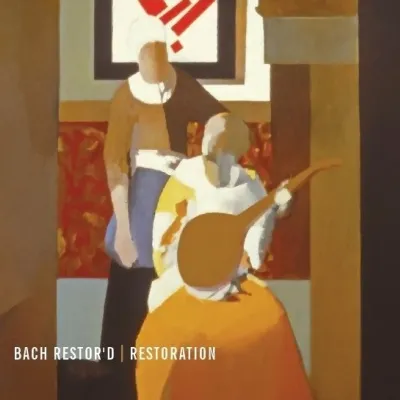
Rattle Records RAT-D174, 2026
Did Bach write another orchestral overture suite? This recording is Restoration’s own reconstruction of an original version for baroque ensemble of the magnificent Overture-suite for harpsichord solo published by Bach in B minor. Click here for sample tracks and purchase details available on the Rattle Records website. CD purchase includes free download of Restoration’s recording of Rameau’s beautiful Entrée de Polymnie from Les Boréades.
Lucinda Moon and Bronwen Pugh – baroque violins
Alison Salmons – baroque viola
Emma Goodbehere – baroque cello
Eric Scholes - violone
Robert Petre – harpsichord
Recorded by John Neill at Stella Maris chapel, Seatoun, Wellington, 23-25 September 2024.
Produced and mixed by Restoration and John Neill. Production assistant: Heather Gummer.
Cover image: Vermeer with Malevich (1984) by John Drawbridge (Massey University collection; photo Michael Roth). Design: UnkleFranc
The Ouvertüre nach Französischer Art was published by JS Bach in 1735 in a version for solo harpsichord in the key of B minor. But the work also exists in an even earlier version, a manuscript written in the key of C minor. This is believed to be the original transcription of his orchestral work, now lost. Bach then transposed his transcription down to B minor for publication – downward transposition was the standard process used by Bach when he transcribed orchestral music such as his violin concerti for harpsichord.
The French Overture is a superb model of the 17th-18th century overture suite. The initial Overture movement is vast and splendid, with an over-arching symmetrical structure – a majestic processional opening and closing, framing a multi-sectional central fugue. It is followed by seven sets of dances, examples of most of the dance types popular at the time.
The characteristic rhythmic inflection and tempo of each dance, known to us from contemporary choreographies and dance treatises, ensures the rich variety of style and mood of the whole work. Notable by its absence here is the Allemande, which appears in every other solo instrumental suite by Bach, but in none of his orchestral suites. The absence of the Allemande in the French Overture is further evidence of its original conception as an orchestral rather than solo harpsichord work.
Both the French Overture and its companion piece, the well-known Italian Concerto, can be seen as examples of the long-standing tradition in the baroque period of arrangements of orchestral and chamber music for keyboard, to make them more accessible to both professional musicians and music enthusiasts.
It is generally accepted that a great many works written by Bach, particularly orchestral and chamber music, have been lost. Bach and his contemporaries would have composed dozens, even hundreds of these suites, as they were frequently required for court balls and other ceremonial occasions. Although this reconstruction of the French Overture must always remain just that, a speculative endeavour, it may nevertheless go some way to filling the gaps in the legacy of Bach’s genius.